How can we accelerate maritime electrification while managing battery-related risks?
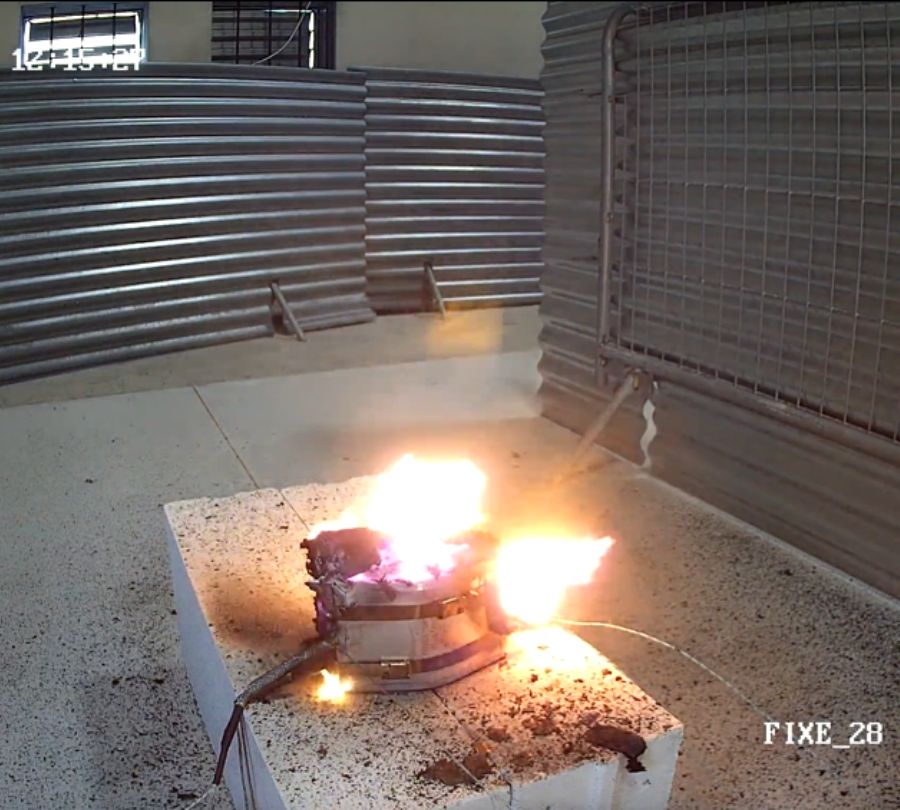
On September 15, 2026, three full-scale thermal propagation tests were conducted at SERMA’s testing facilities in Neuville-aux-Bois to assess how different battery technologies and safety solutions perform under thermal runaway conditions.
The tests revealed:
- Rapid thermal runaway followed by a major fire involving a cell using NMC chemistry.
- Gas venting without ignition in cells using LFP chemistry.
- Sequential cell venting without propagation to adjacent cells in the SWITCH BatModul® 8.3 kWh module, which uses LFP cells.
In the latter test, immersion in a dielectric fluid helped limit thermal propagation, while a dedicated system collected, channelled and vented gases outside the battery pack.
Above all, these tests highlight one key finding: battery safety depends on more than cell chemistry alone.
It requires a comprehensive approach combining:
- Battery pack design and its surrounding environment
- Thermal propagation control
- Cooling and insulation
- Gas containment and evacuation
These results provide manufacturers with valuable, real-world data to design, test and integrate safer battery systems on board vessels.
They also demonstrate that technical solutions are already available to better control the consequences of thermal runaway. Further testing and validation on a larger scale will be essential to support the development of maritime electrification.
The next challenge for the industry is to translate these test findings into industrial solutions that can support the long-term decarbonisation of the maritime sector.
The tests were presented to more than 60 maritime industry stakeholders during a technical event co-organised by GICAN, SERMA and SWITCH.