Several complementary techniques can be combined to identify a foreign particle on a pharmaceutical filter: scanning electron microscopy (SEM) to examine its morphology, EDS analysis to determine its elemental composition, and FTIR spectroscopy to identify, in particular, organic and polymeric materials.
The detection of a foreign particle on a pharmaceutical filter is always an alert for quality and production teams. Whether it is an isolated particle, a fibre or a residue observed during an inspection, the presence of an unidentified material immediately raises several questions: What is it? Where does it come from? Could it affect the product or the manufacturing process?
In an environment subject to particularly stringent regulatory requirements, it is essential to identify a foreign particle quickly in order to make the right decisions and limit the impact on the production chain.
Science et Surface, SERMA Technologies’ materials analysis and characterisation laboratory, supports industrial companies in identifying particles, fibres, residues and other contaminants using a range of surface and materials analysis techniques.
Why is identifying a foreign particle essential in the pharmaceutical industry?
Pharmaceutical processes involve numerous items of equipment, filters, pipes, seals, transfer systems and materials that come into contact with manufactured products. Despite the precautions in place, an unknown particle or unexpected deposit may appear at various stages of the process.
When a foreign particle is detected, quality teams must quickly determine whether:
- it is an external or internal contamination;
- the particle comes from production equipment;
- it is associated with a material used in the process;
- its origin can be identified with certainty;
- its impact warrants further investigation.
Without analytical characterisation, it is often impossible to answer these questions objectively.
Identifying the foreign particle therefore becomes a key step in guiding the investigation and enabling decisions to be made on the basis of objective data.
A foreign particle detected on a pharmaceutical filter
As part of an investigation carried out for a company in the pharmaceutical industry, Science et Surface was asked to analyse a foreign particle observed on a filter used during the manufacturing process.
Given the associated quality implications, an urgent analysis was initiated to identify the exact nature of the particle and quickly provide decision-making support to the teams responsible for production.
The objective was straightforward:
to determine the composition of the foreign particle in order to understand its potential origin and assess its impact on the process.
To address this issue, several complementary materials characterisation techniques were implemented.
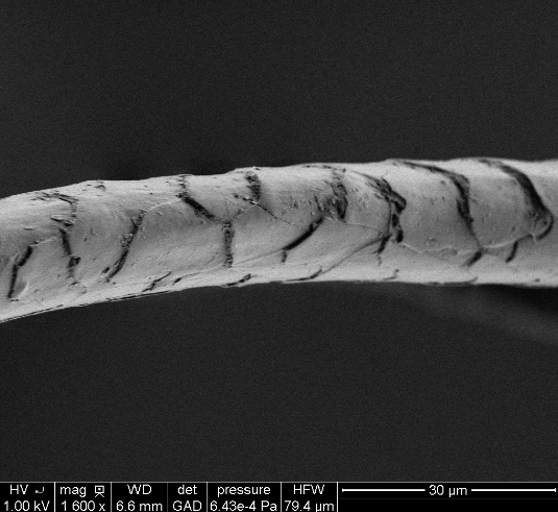
Examining the particle using scanning electron microscopy
The first step in the investigation involved examining the foreign particle using scanning electron microscopy (SEM).
This technique produces highly magnified images and reveals details that are not visible using conventional optical microscopy.
Examination of the contaminant can be used to assess, in particular:
- its morphology;
- its size;
- its texture;
- its surface condition;
- whether it has fragmented.
This information often provides an initial indication of the nature of the foreign particle observed.
Depending on its shape, the investigation can sometimes be directed towards particular material families: metallic particles, polymer fragments, natural or synthetic fibres, mineral deposits or residues from industrial equipment.
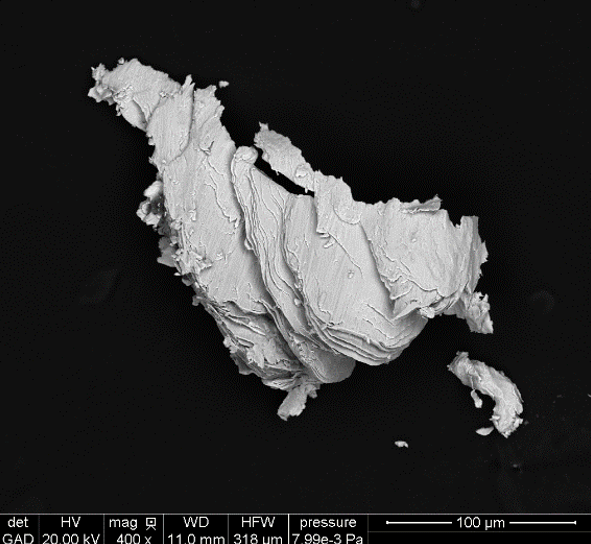
SEM image of a metal shaving acquired in ERD mode.

SEM image showing the morphology of a natural fibre, acquired in ERD mode.
Determining elemental composition using EDS
Microscopic examination was supplemented by EDS (Energy Dispersive Spectroscopy) analysis, directly coupled to the electron microscope.
This technique identifies the main chemical elements present in the particle.
Elemental analysis provides valuable information for identifying the origin of a foreign particle. It can reveal the presence of:
- metals;
- oxides;
- mineral compounds;
- fillers incorporated into certain polymers;
- elements characteristic of materials used in production equipment.
Combining SEM and EDS therefore provides an initial, detailed characterisation of the contaminant.
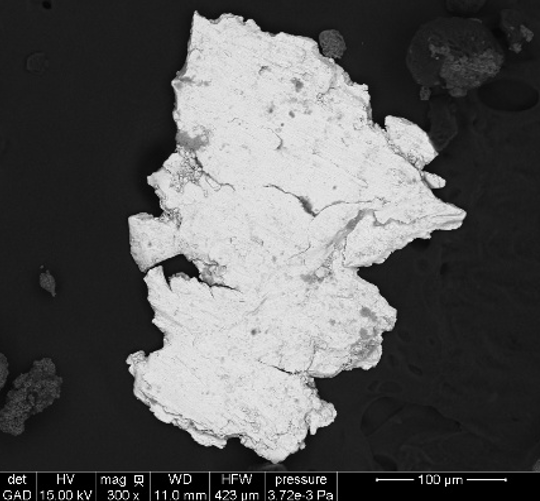
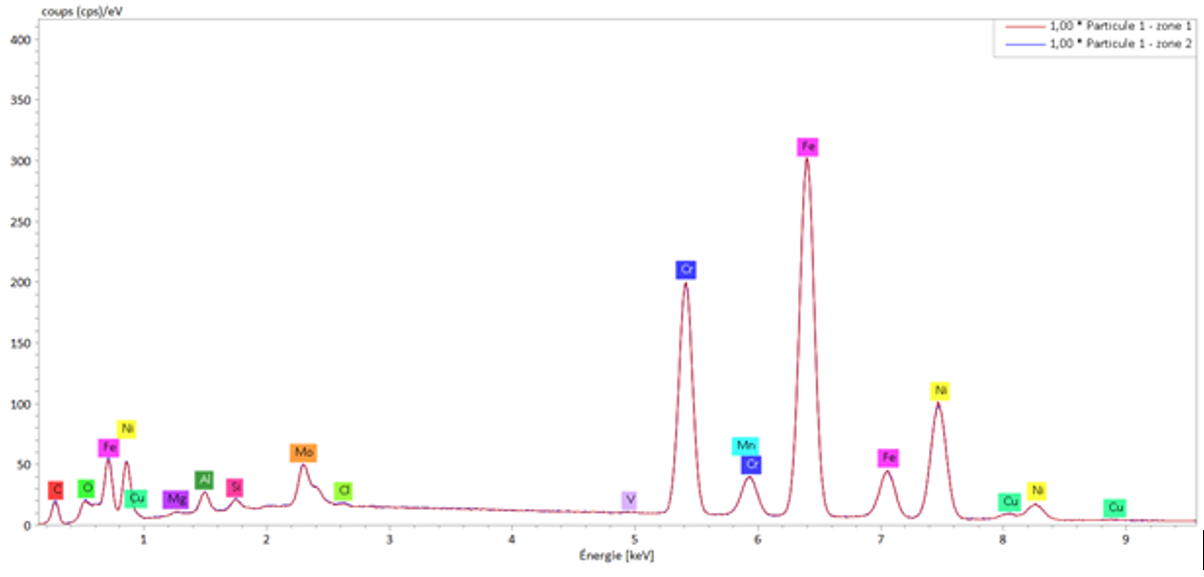
SEM image of a metal shaving and its associated EDS spectrum for elemental composition analysis.
Identifying the material using FTIR spectroscopy
To refine the identification of the foreign particle, Fourier-transform infrared (FTIR) spectroscopy was also performed.
This method is particularly well suited to identifying organic and polymeric materials.
Each material has a specific infrared signature, which can be compared with reference databases to determine its nature.
FTIR analysis is commonly used to identify:
- polymers;
- elastomers;
- natural or synthetic fibres;
- organic and biological residues;
- certain industrial additives;
- material degradation products.
In this investigation, this technique complemented the information obtained through SEM-EDS and helped confirm the identification of the contaminant.
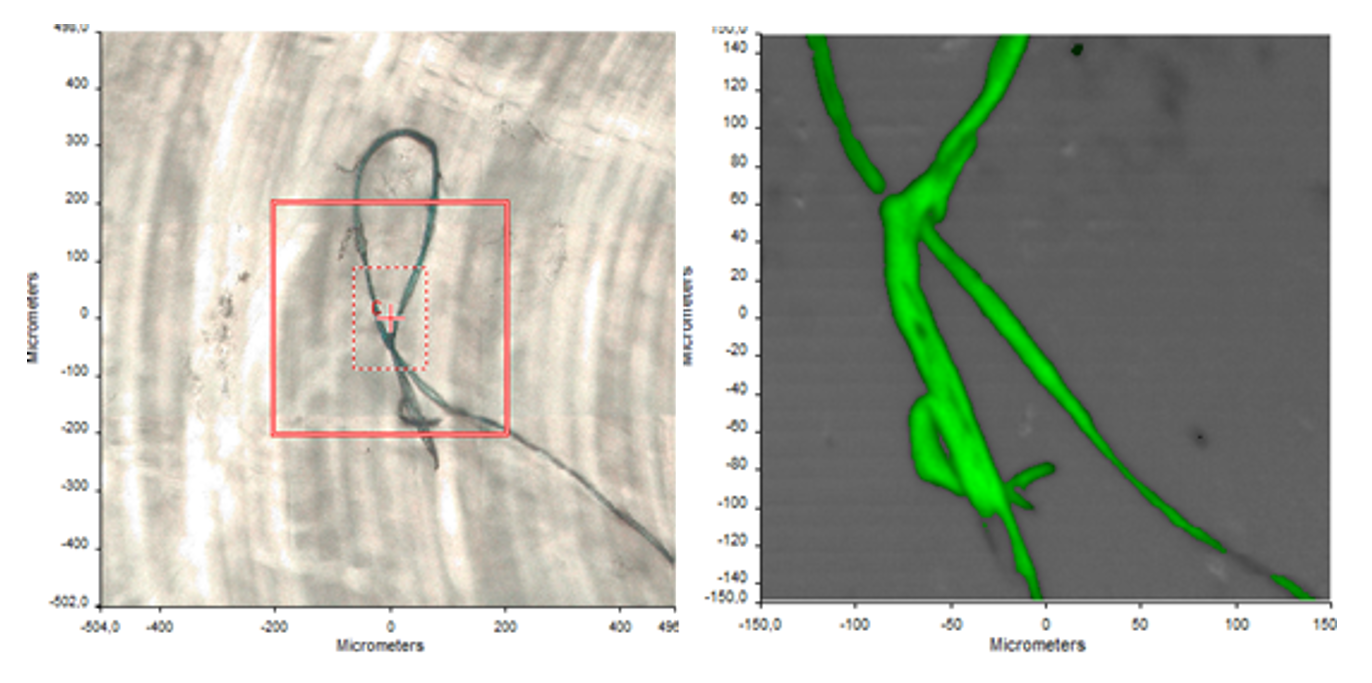
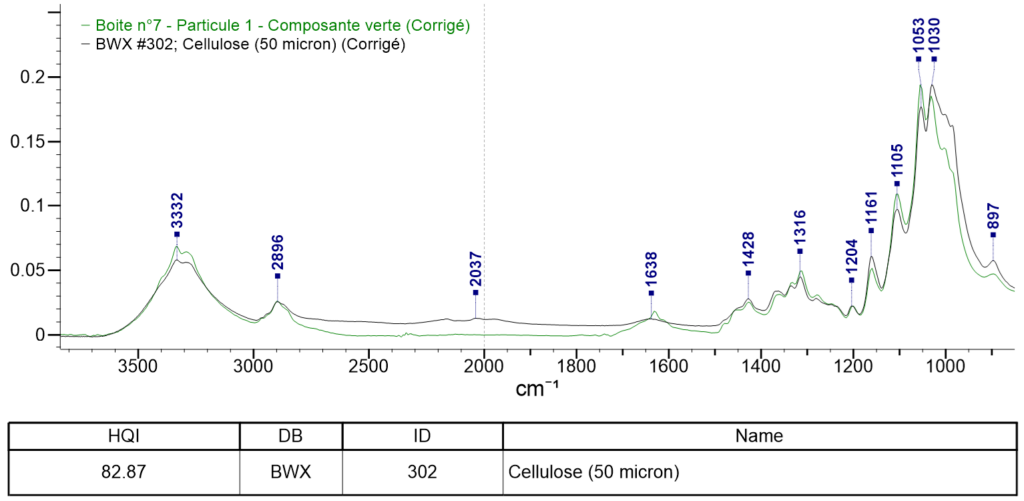
Identification of a cellulose fibre: optical microscopy, FTIR mapping and comparison of the infrared spectrum with reference libraries.
Analysis performed under ISO/IEC 17025 accreditation
When quality or regulatory decisions are involved, the reliability of analytical results is a determining factor.
Science et Surface, a SERMA Technologies laboratory, is accredited by COFRAC in accordance with the ISO/IEC 17025 standard for foreign-particle investigation and identification services, within the limits of its accredited scope.*
This accreditation attests to the laboratory’s technical competence for the activities covered by that scope.
This approach enables industrial companies to obtain robust analytical data when they need to assess the impact of a quality event or document an investigation.
Accreditation No. 1-7192. Scope available at www.cofrac.fr.
Result: identifying the nature of the foreign particle
The combined SEM-EDS and FTIR approach made it possible to determine the nature of the foreign particle.
Depending on the samples analysed, this approach can be used to identify, for example, a cotton fibre, a metal shaving, a polymer or a fibre of biological origin.
The results enabled the pharmaceutical site’s teams to:
- identify the composition of the contaminant;
- focus their investigation on its origin;
- assess its potential impact on the process;
- quickly decide on the actions to be implemented across the production chain.
In this type of situation, the speed of the investigation is often just as important as the quality of the results. Rapid identification helps shorten investigation times and accelerate decision-making.
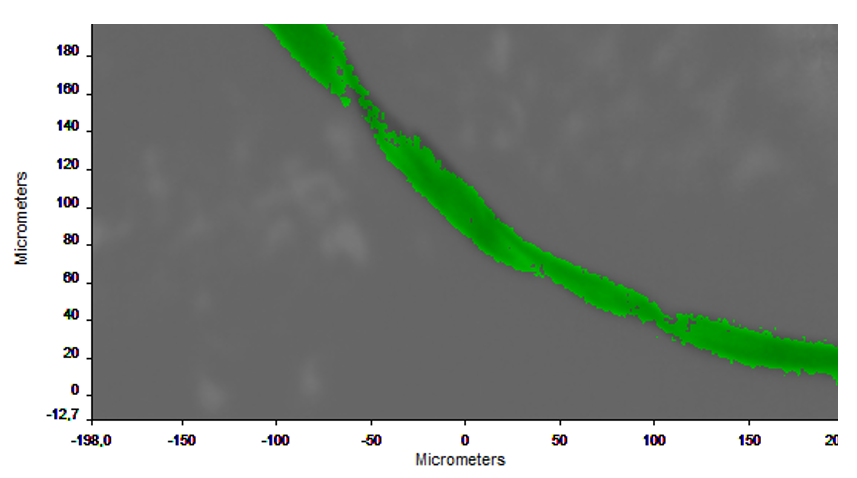
FTIR mapping of a cotton fibre
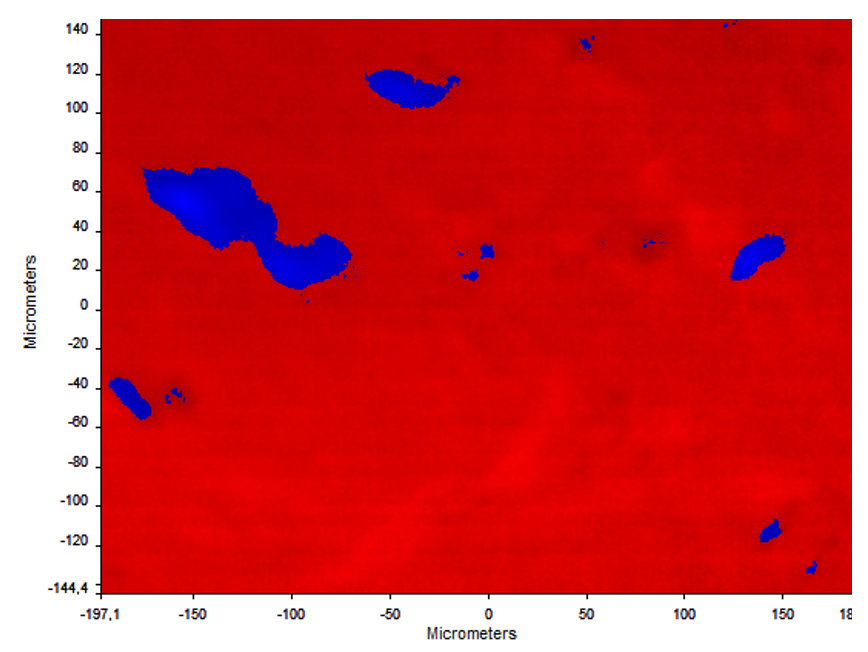
FTIR mapping of a polypropylene (PP) particle containing calcium carbonate (CaCO₃) filler (PP shown in red, CaCO₃ in blue).
Why combine SEM-EDS and FTIR to identify a foreign particle?
Identifying a foreign particle generally requires several complementary techniques.
- SEM provides information about the particle’s morphology.
- EDS determines its elemental composition.
- FTIR provides molecular identification and is particularly effective for organic and polymeric materials.
These complementary techniques make it possible to cross-check results in order to characterise unknown particles. The choice of techniques depends in particular on the size, nature and amount of material available.
Combining SEM-EDS and FTIR is therefore a suitable approach for analysing foreign particles, identifying particles and investigating contamination in demanding industrial environments.
Key takeaways
Identifying a foreign particle on a pharmaceutical filter is an essential step in ensuring the safety of manufacturing processes and limiting the impact of a quality event.
By combining complementary techniques such as SEM-EDS and FTIR, it is possible to determine the nature of an unknown particle and provide industrial companies with objective information to guide their investigations.
When a decision needs to be made quickly about whether production should continue or a quality risk should be assessed, a timely analytical investigation is a valuable decision-making tool.
Do you need to identify a particle, fibre or residue on a pharmaceutical filter? Contact the Science et Surface experts at SERMA Technologies to determine which analyses are best suited to your nee